


Identifying turn-taking moments in triadic healthcare conversations
June 2025
design
robots
As an Interaction Technology student at the University of Twente, I explored how a third party (e.g., a robot assistant) can intervene in doctor–patient conversations without disrupting trust or the flow of care. The core question was not “what should an assistant say?”, but “when is it socially acceptable to speak at all?”
View the full report here.
What I did
In a team of 2, I designed and studied simulated triadic consultations (doctor, patient, assistant) to capture realistic conversational dynamics while keeping the setting controllable. We recorded six sessions across three primary-care scenarios: allergic reaction management, viral illness assessment, and musculoskeletal pain consultation.
Approach (privacy-aware, multimodal)
Instead of full verbatim transcripts, we used a structured observation log with timecodes, short dialogue summaries/keywords, pause duration, gaze direction, and prosodic end cues (rising/falling pitch). This let us analyze turn-taking opportunities while explicitly considering privacy constraints that are typical for healthcare contexts.
Key findings
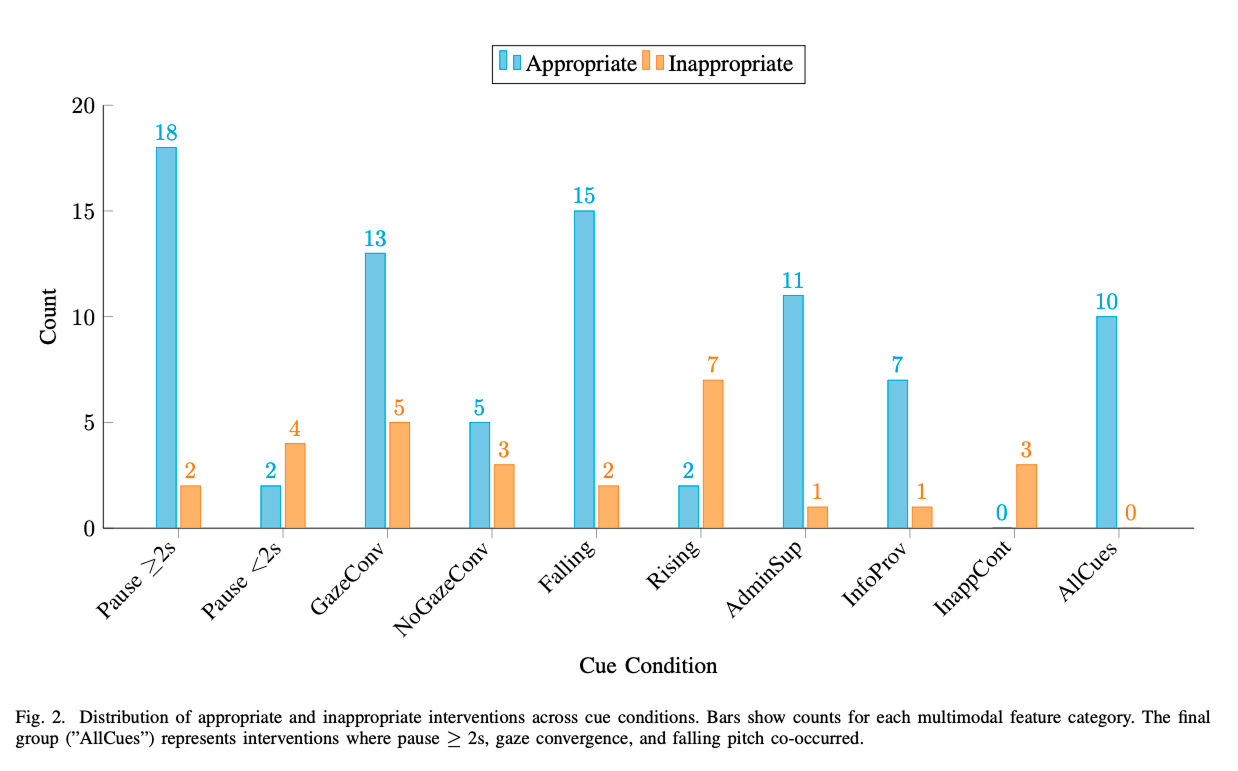
Across 26 assistant interventions, timing strongly correlated with conversational “openness”: interventions after pauses of at least 2 seconds were judged appropriate 90% of the time (18/20), versus 33% (2/6) for shorter pauses.
Gaze mattered as a social permission signal: most appropriate interventions happened when doctor and patient gaze converged toward the assistant (13/18), while inappropriate ones often occurred during sustained doctor–patient mutual gaze (5/8).
Prosody reinforced this: interventions following falling-pitch completion cues were much more likely to be appropriate (15/17) than after rising pitch (2/9).
When all three cues aligned (pause ≥2s + gaze convergence + falling pitch), every intervention was appropriate (10/10).
Design implications
This project translates conversation analysis into actionable interaction design constraints for socially intelligent assistants in sensitive settings: wait for longer pauses, treat gaze convergence as a “go/no-go” gate, and respect strict content boundaries (administrative/informational support rather than clinical opinions). It also highlights a product-relevant insight: being able to withhold an intervention can be as important as speaking, especially when context is incomplete.