


The Robot Enactment Game (REG)
June 2025
design
robots
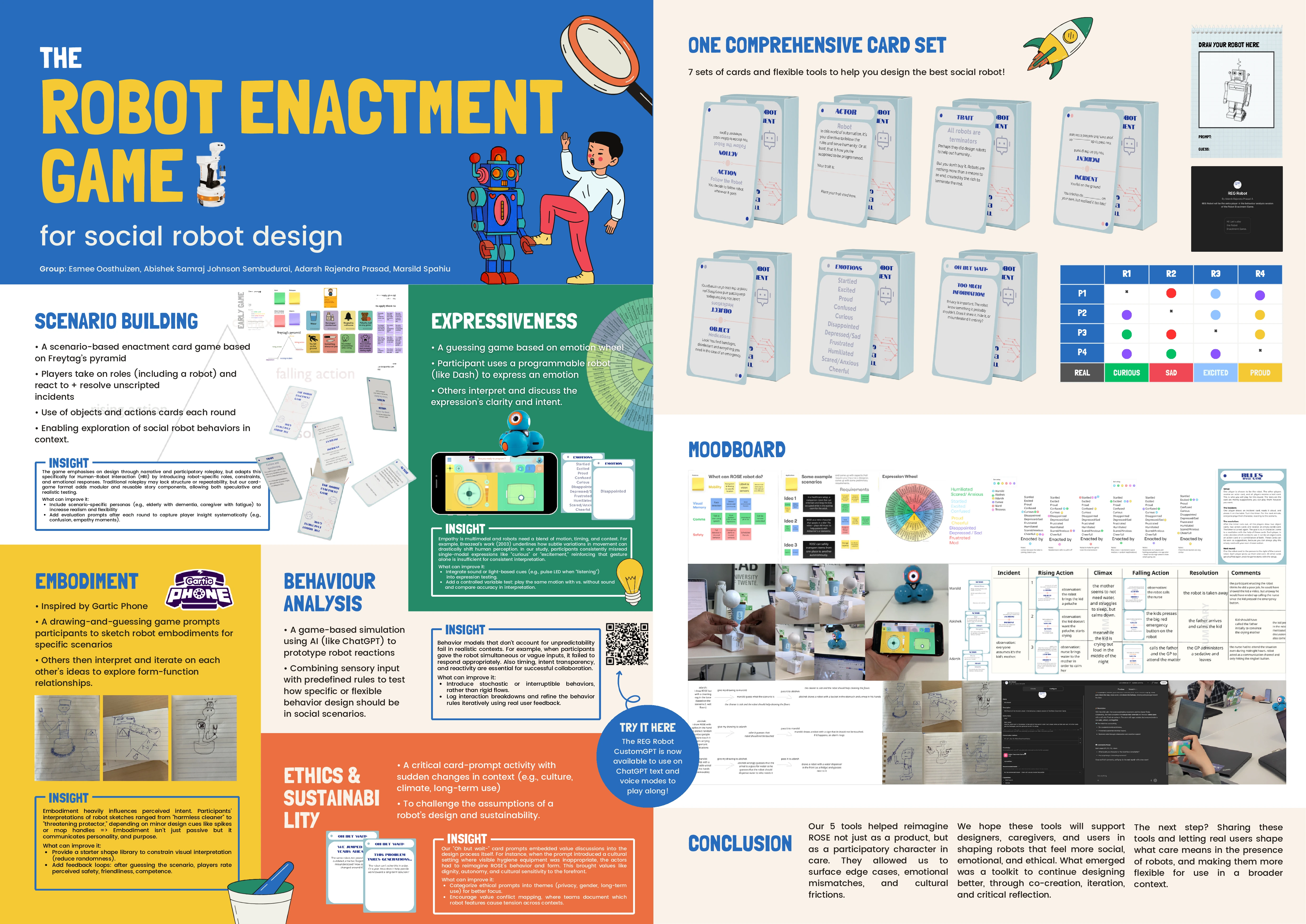
For our Systemic Responsible Design project on social robot design, we created The Robot Enactment Game (REG), a card-based toolkit to explore how social robots should look, feel, and behave in care scenarios—beyond just their technical capabilities.
As an Interaction Technology designer, my role focused on turning abstract HRI questions into playful, repeatable design games that real stakeholders can use.
What REG is
REG is a collection of mini-games and card sets that help people co-create and critique social robots through narrative, play, and reflection.
It includes tools for scenario building, robot expressiveness, embodiment sketching, behavior analysis with AI, and ethics & sustainability prompts, all centered around a fictional care robot called ROSE.
The five tools
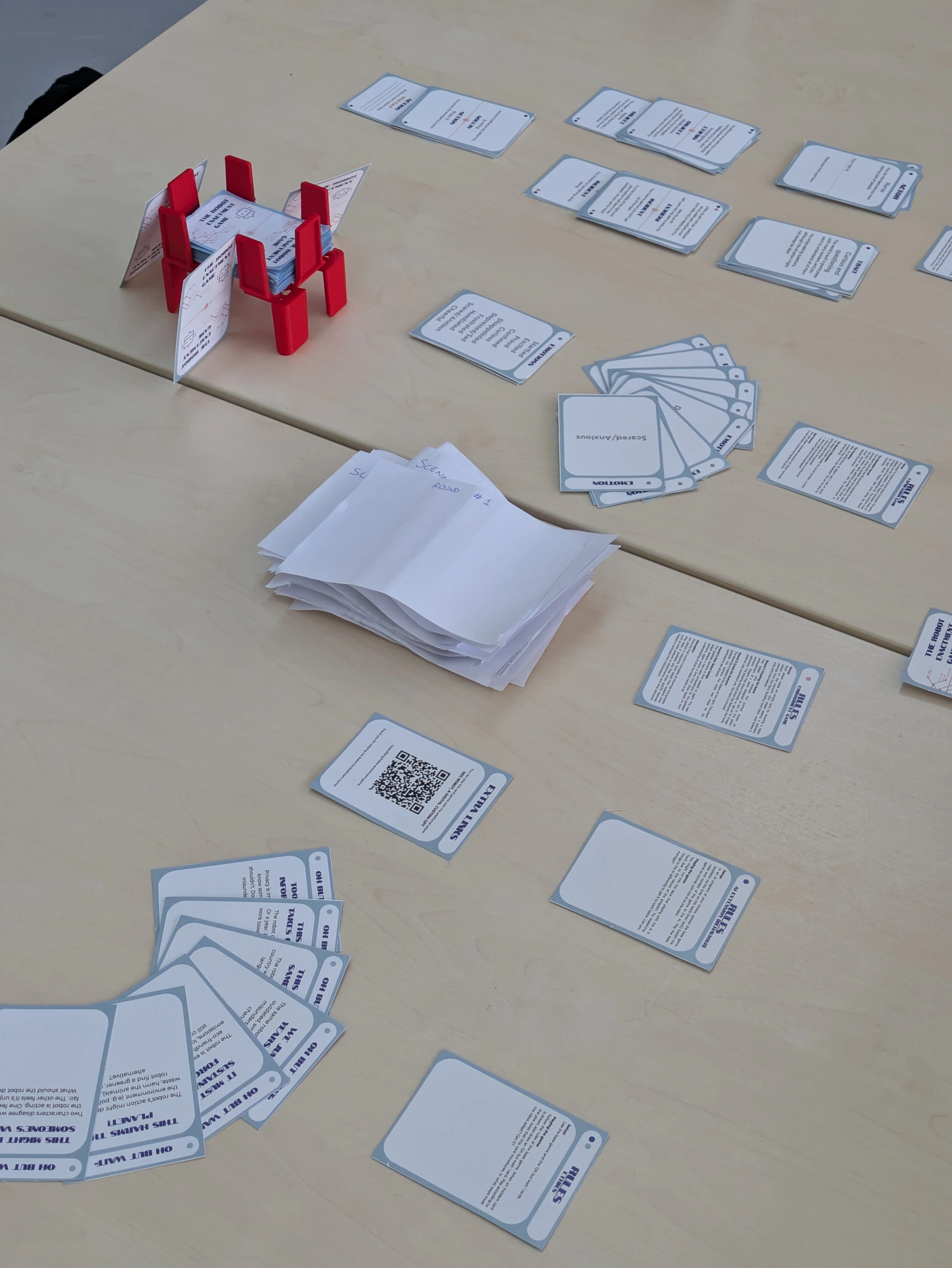
We designed a scenario-building enactment game where players adopt roles (including a robot) and act out incidents using object and action cards, structured by Freytag’s pyramid to keep stories coherent and reusable.
An “Expressiveness” guessing game uses a small programmable robot to perform emotions from an emotion wheel, revealing how easily (or not) people can read robot feelings from motion alone.
An “Embodiment” drawing game (inspired by Gartic Phone) lets participants sketch and reinterpret robot forms for different care situations, showing how small visual cues change perceived intent from “harmless cleaner” to “threatening protector.”
A behavior analysis game uses an AI agent (like ChatGPT) to prototype robot responses to messy, ambiguous inputs, surfacing where rigid behavior rules break down in realistic social interaction.
Finally, ethics & sustainability prompts (“Oh but wait—” cards) inject sudden changes in context—culture, privacy, long-term use—to force players to rethink ROSE’s design values in situ.
Why this matters
Together, these tools shift the robot from a fixed product into a participatory character in care, making it easier to spot edge cases, emotional mismatches, and cultural frictions early in the design process.
For me as a designer, REG is a way to operationalise “responsible” HRI: it gives caregivers, patients, and designers a shared language—cards, sketches, enactments—to negotiate what a social robot should and should not do.